- Quick contact:
- 801.359.2035

Understanding Diamond Symmetry for Your SLC Selection
There are a number of factors that go into the quality of a given diamond, and while the most well known here are the “Four Cs” that many of our readers are already familiar with, there are also a few others that play a major role. One of these that’s particularly important for the light interaction and brilliant appearance of a diamond: The symmetry of the diamond.
At AAA Jewelers, we’re proud to offer a variety of stunning GIA diamonds, from engagement rings and wedding rings to bracelets, pendants and many forms of fashion jewelry to clients throughout Salt Lake City and other parts of Utah. We’ll assist you with finding the diamond of your dreams using a number of potential factors, from the Four Cs to several others that may impact your choice — including diamond symmetry. What does this concept refer to, which other diamond features is it related to, and how is it graded in diamonds? Here’s a primer.
Diamond Symmetry Basics
When we talk about diamond symmetry, what we’re referring to is how well-aligned the facets of a diamond are. If the symmetry is off, it can have an impact on how much sparkle you get from a stone — and since beauty is largely about what looks good to the human eye, even the smallest issues related to symmetry can influence value.
Specifically, symmetry speaks to how well the edges of the facets on the top and bottom of the diamond line up along the girdle — and around the rest of the diamond. The greater the symmetry, the better the light return, which is what allows the diamond to light up and shine brilliantly.
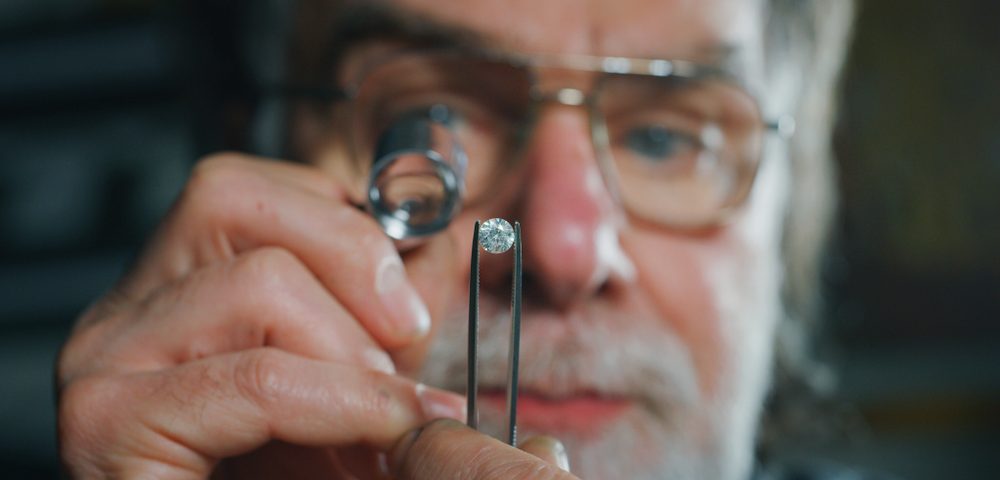
If your goal is to get a brilliant diamond, you should place extra emphasis on symmetry; it’s something that can be graded by GIA, one of the leading grading labs in the world. It’s also possible for jewelers to determine whether or not a diamond has good symmetry just by looking at it with the naked eye, but, naturally, if you’re not a professional jeweler it can be hard to know whether or not what you’re seeing is accurate.
Factors Impacted by Symmetry
Because it’s so closely related to light interaction within the diamond, diamond symmetry is closely connected to brilliance. A symmetrical diamond will allow light to travel through it in optimal ways, which will allow the stone to display the levels of sparkle that you’d expect from a high-quality diamond. On the flip side, a diamond with poor symmetry will send light at defective angles, causing glare and other issues that can leave your diamond looking rather dull, even if it is naturally flawless.
Diamond symmetry also speaks to how well the facets line up; when they’re all facing perfectly upwards or downwards (and laterally), this makes it much easier for light to get into the stone’s interior, which will make for better color development as the stone is worn. A diamond’s polish is also heavily impacted by symmetry; more on this below.
How Diamond Symmetry is Graded
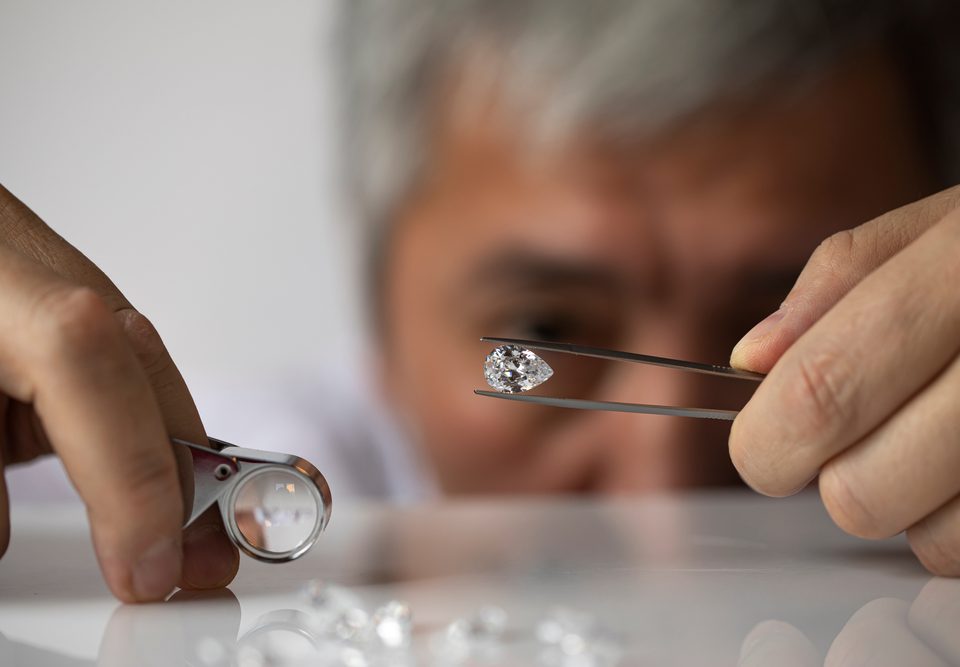
As we noted above, diamond symmetry is an element that is regularly graded by the GIA. These grades are based on visibility and presence of deviations at 10x magnification, just like most other grading needs within the GIA scope. Factors evaluated will include misalignment, missing facets, off-center tables and more.
Here are the grades possible for diamond symmetry under the GIA definitions:
- Excellent: These diamonds have very few, or sometimes no, deviations. They are really close to perfect shape and work with the light extremely well.
- Very Good: These diamonds, while not flawless in terms of symmetry, have few or no visible flaws when viewed under 10x magnification. They’re still going to show a good deal of brilliance but will have slight optical issues that may be noticeable when they’re being looked at up close.
- Good: These diamonds can suffer from more noticeable issues with how they handle light — for example, you may notice some areas where the diamond doesn’t catch the light quite as well.
- Fair: Fair symmetry diamonds will have several deviations, plus misalignments that can be seen from a few feet away.
- Poor: These diamonds have serious misalignments and issues that can be seen even by someone who isn’t wearing their glasses. They’re going to look very hazy under 10x magnification, with a number of impurities and other problems.
Diamond Symmetry and Diamond Polish
Some who are familiar with diamonds may have already realized something while reading above: Diamond polish is another area that’s closely related here. Specifically, just like polish, it can be tough to tell the true difference between various levels, even if you’re an experienced pro in the industry.
For instance, even longtime experts in the field may struggle to tell the precise differences between a diamond with a Good symmetry rating and an Excellent rating — this is similar to the various polish grades, which do differ, but often in such subtle ways that they’re barely noticed.
For this reason, even those who count symmetry as one of their most important factors shouldn’t put too much weight into it. There’s no need to spend tons of extra money on a higher grade of symmetry if you can’t even spot the differences with your eyes — instead, you could put that additional money toward purchasing a better quality diamond, which you’ll probably notice more prominently.
Diamond symmetry is one of the “lesser” elements that determine how well a stone will work with light and other factors to make it sparkle, but it still holds value. For more on how to evaluate this area, or to learn about any of our diamonds for sale in Salt Lake City or nearby areas, speak to the staff at AAA Jewelers today.